
- Key Facts
- Rating6.5/10
- Why this pickAt $899 the GO7 XSR undercuts the 9-inch GO9 XSE by $200, but the 800x480 screen has a fraction of the GO9's pixel count, which shows on split-screen views. It suits a smaller helm or a secondary station where full-HD chart detail matters less than fitting the display in the available space.
Pros
- $200 cheaper than the 9-inch GO9 XSE, real savings for a tighter budget
- GPS and C-MAP Discover charts work out of the box
- Bluetooth and Wi-Fi both listed, one radio more than the GO9
- Radar-ready with plug-and-play connectivity to Simrad radar units
Cons
- 800x480 resolution is noticeably softer than the GO9's 1920x1080
- No transducer in the box, sonar and fish-finding don't work until you add one
- Split-screen views (chart plus sonar plus data) get cramped at this resolution and size
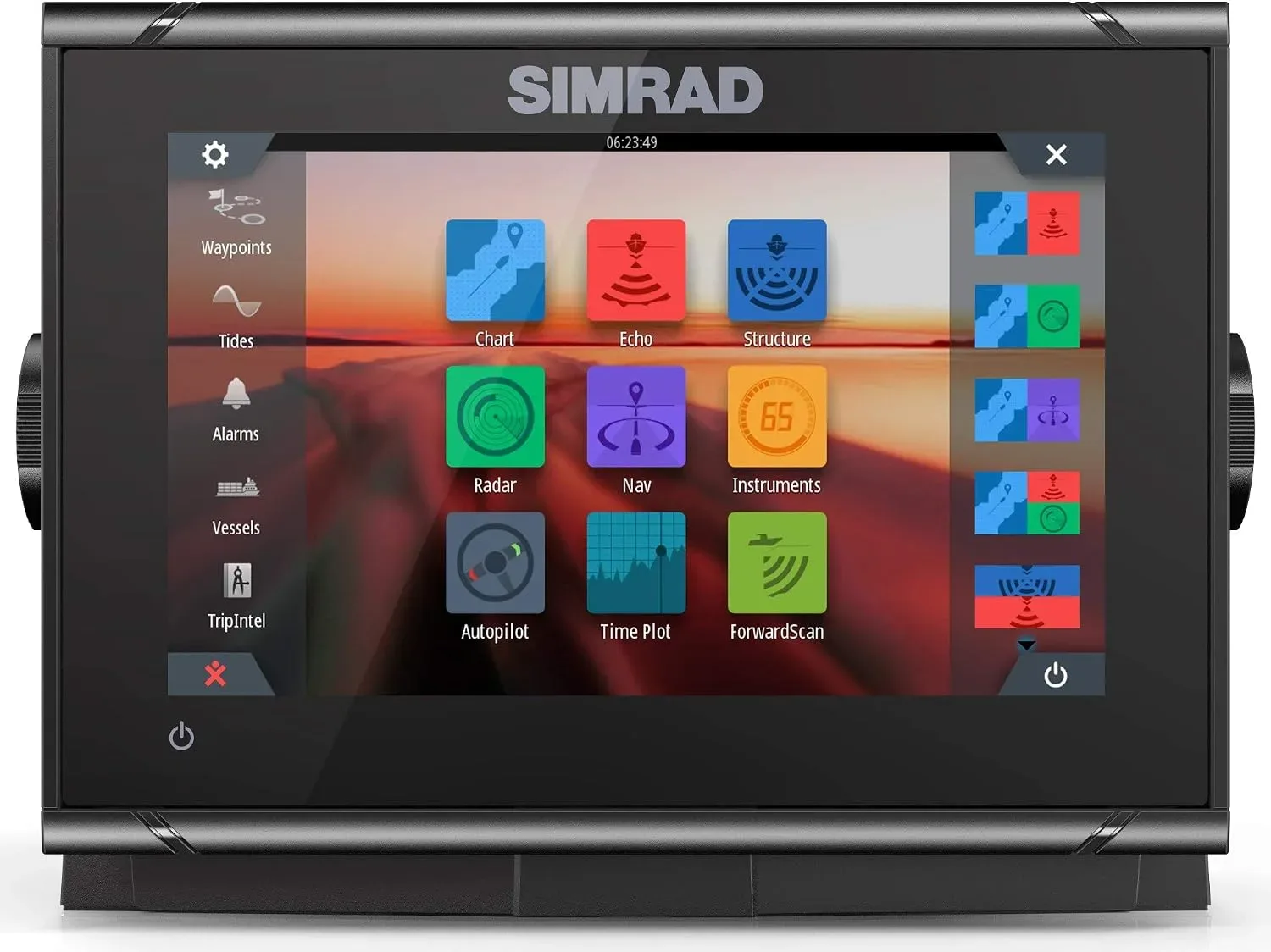
The Simrad GO7 pulls real search volume of 3,260 across its query variants in this dataset, including "simrad go7 xse" (210), "simrad go7 xsr" (170), and "simrad go7xse" (90). That variant spread is itself informative: the model Simrad currently sells under the GO7 name is officially the GO7 XSR, model number 000-14078-002. We'll refer to it as the GO7 throughout, which is how most people search for it, but XSR is the real name printed on the unit.
Simrad GO7 XSR Specs
| Spec | Value |
|---|---|
| Screen | 7-inch touchscreen, 800 x 480 |
| Sonar/transducer | None included, CHIRP sonar works once a transducer is purchased separately |
| GPS | Built-in, with preloaded C-MAP Discover charts (US and Canada) |
| Connectivity | Bluetooth, Wi-Fi, NMEA 2000 |
| Price (no transducer) | $899.00 at Amazon.com |
What the GO7 XSR Actually Includes
The standard listing is the no-transducer configuration: the GO7 XSR display, a mounting bracket, a dash mount kit, an edge bezel, a power cable, and a sun cover. Simrad also lists a separate HDI transducer bundle under a different ASIN. As with the larger GO9, "GO7" by itself describes a chartplotter, and sonar capability depends on which transducer gets paired with it afterward.
Where the GO7 does pull ahead of the GO9 on paper: it's the only one of the two that lists Bluetooth alongside Wi-Fi. It's a small detail, but it's a real, confirmed difference between the two listings, not something either product page treats as a headline feature.
The GO7 XSR's standard box has no transducer, same as the GO9, its one confirmed edge over its bigger sibling is Bluetooth radio, listed alongside Wi-Fi on the GO7's spec sheet but absent from the GO9's.
The Resolution Trade-off
The GO7's 800x480 screen is where the price savings actually shows up. Compared to the GO9's 1920x1080, that's roughly a fifth of the pixel count on a screen only about 25% smaller. In practice, that means chart labels and depth numbers stay readable at a glance, but running a split view with chart, sonar, and data panels open at once gets genuinely cramped. If your boat only has room for a 7-inch display, or the budget tops out at $899, that trade-off is the real cost of the smaller footprint, not just a marketing footnote.
GPS and the preloaded C-MAP Discover chart card work identically to the GO9: Vector Charts, custom depth shading, tides and currents, and bathymetric contours across the US and Canada, ready the moment the unit powers on. Radar connectivity is also identical, with plug-and-play support for Simrad's radar line.
At roughly a fifth of the GO9's pixel count, the GO7's 800x480 screen keeps single-panel chart reading legible, but a crowded split view (chart + sonar + data) is the real cost of the smaller footprint and lower price.
Sonar Still Needs a Transducer
Same as every model in the GO series, sonar and CHIRP fish-finding only activate once a transducer is connected. Simrad's own product description states this plainly rather than implying the display alone finds fish. Anyone comparing the GO7 against a standalone fish finder that ships with a transducer included should factor that extra purchase into the real total cost before deciding this is the cheaper option.
Like every GO-series unit, the GO7 is a chartplotter first, sonar and CHIRP fish-finding only turn on once you add a transducer, a cost worth factoring in before comparing it to a standalone fish finder that ships with one.
GO7 vs. GO9: Which One Fits Your Boat
| Model | Screen | Resolution | Price (no transducer) |
|---|---|---|---|
| Simrad GO7 XSR | 7-inch | 800 x 480 | $899.00 |
| Simrad GO9 XSE | 9-inch | 1920 x 1080 | $1,099.00 |
If helm space is genuinely tight, or $899 is the ceiling, the GO7 is a real, functional chartplotter that does everything the GO9 does at a lower resolution. If you can stretch the extra $200 and have the mounting space, our Simrad GO9 review covers why the sharper screen is worth it for anyone running multiple data panels at once.
GPS, chart data, and radar readiness are identical between the GO7 and GO9, the real decision comes down to whether $200 and mounting space buy enough resolution to matter for how you'll actually use the screen.
Verdict: Is the Simrad GO7 Worth Buying?
Buy it if a 7-inch footprint is what your dash or console actually allows, or the $200 savings versus the GO9 matters more than screen resolution. GPS, charts, and radar readiness are identical to the larger model.
Skip it if you plan to run chart, sonar, and data panels simultaneously, the 800x480 resolution gets crowded fast in that layout, and the GO9's screen handles it far better. See our buying guide for how to weigh screen size against budget more broadly.
Best fit is a smaller helm or a secondary station where fitting the display matters more than chart resolution, anyone running multiple panels at once will feel the GO7's lower pixel count more than the price savings.