
"Best fish finder" and "best fish finder for the money" are the two phrases doing most of the real search volume in this cluster, well ahead of specific questions like "how to choose a fish finder." That tells you something about how people actually shop for one: they want the short list of what separates a good unit from a bad one, not a lecture on sonar physics. This guide gives you that list, CHIRP, side and down imaging, GPS combos, and a real budget framework, without repeating manufacturer marketing copy as if it were a technical spec.
How a fish finder actually works
Every fish finder, from a $100 portable to a $3,000 GPS combo, does the same basic thing: a transducer converts an electrical impulse into a sound wave, sends it into the water, and the unit calculates distance from how long the echo takes to come back. The math behind that calculation isn't guesswork, commercial units use a speed of sound of roughly 4,921 ft/s in saltwater and 4,800 ft/s in freshwater, which is also why a fish finder's depth reading can shift slightly moving between a lake and the ocean.
Frequency: the tradeoff that decides what you actually see
Frequency is the single biggest lever in how a fish finder behaves, and it's a straight tradeoff: commercial fishing fleets run low frequency (50-200 kHz) for deep-water work, and it's easier to get fine detail on the screen the higher the frequency goes. Side and down imaging modules push this further, typically operating in the 100-500 kHz range, where a higher frequency buys better resolution at the cost of range. In practice: fishing a deep reservoir or offshore, you want to be able to drop frequency to keep seeing bottom; fishing a shallow farm pond or a clear lake, a higher frequency gives you a sharper picture and you don't need the extra range anyway.
CHIRP, without the marketing language
A CHIRP fish finder doesn't send a single fixed-frequency pulse, it sends a signal that sweeps up or down in frequency over time. That sweep has two real, measurable benefits: a lower peak-to-average power ratio than a standard impulse, and it lets the receiver apply matched filtering to the returning echo. The practical result is better target separation, an easier time telling one fish apart from a tightly packed school, or a fish sitting just off the bottom from the bottom itself. That's a real technical improvement, not just a marketing term, though every major brand (Garmin, Lowrance, Humminbird) sells its own CHIRP implementation under a different name, and we haven't independently verified the exact specs of each manufacturer's proprietary chip, not found in available sources for that level of brand-by-brand detail.
| Signal type | Target separation | Best for |
|---|---|---|
| Traditional (single fixed frequency) | Standard, limited by a fixed-frequency pulse | Basic depth and bottom reading, budget units |
| CHIRP (frequency sweeps up or down over time) | Improved, matched filtering makes it easier to resolve two closely-spaced echoes | Telling a single fish apart from a school, or from nearby structure |
Side imaging and down imaging: what they actually add
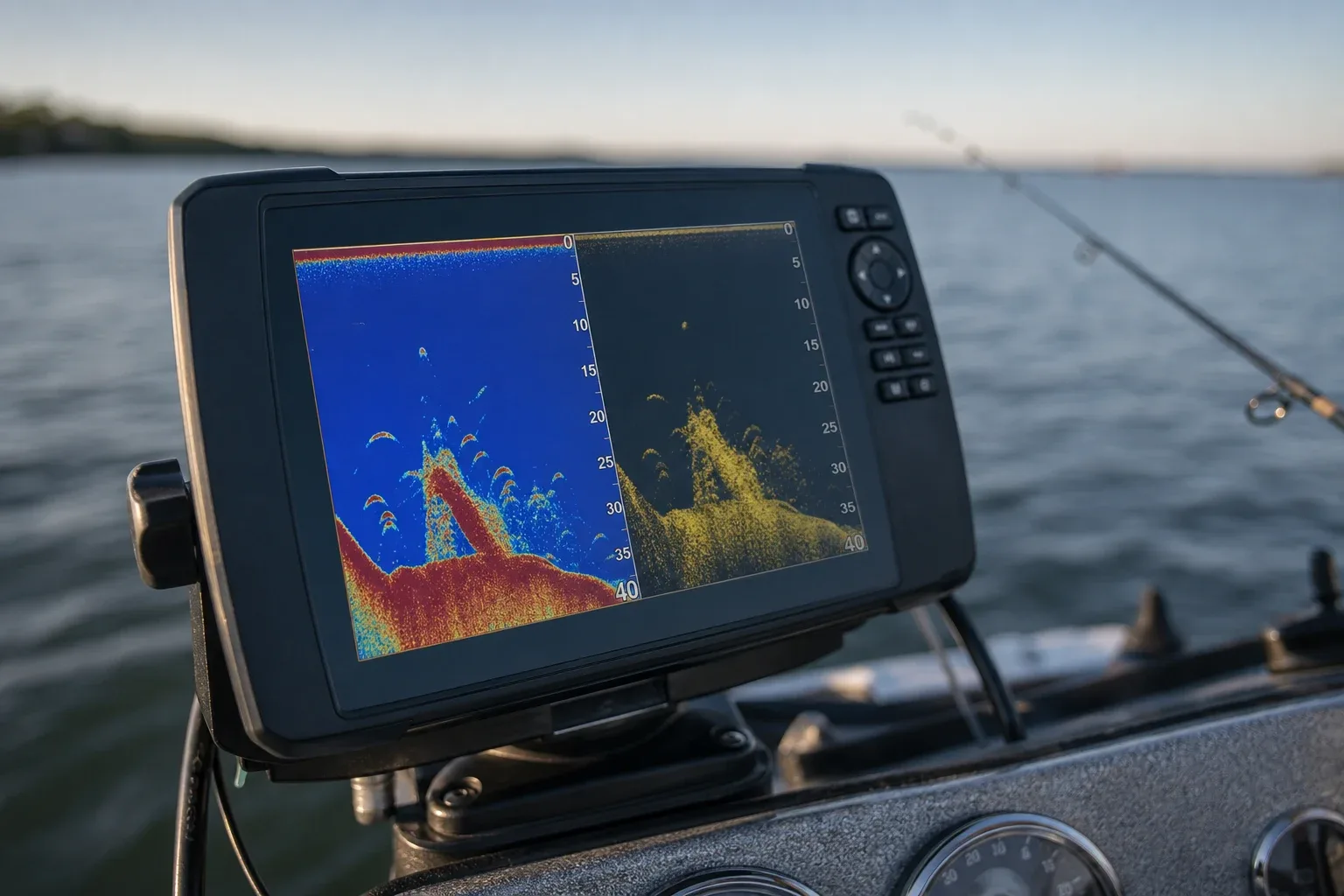
Instead of just the narrow cone directly under the boat, side and down imaging modules emit fan-shaped or conical pulses across a wide angle perpendicular to the boat's path, then stitch the resulting cross-track slices together into one image. That's what lets you scroll past a submerged brush pile, a drop-off, or a school of baitfish sitting off to the side of the boat instead of directly underneath it, you're building a real picture of the bottom, not just a single depth number.
GPS combo or standalone, do you actually need the map?
Modern fish finders increasingly fold GPS, radar, and compass data into one system alongside the sonar itself. On a boat, that's genuinely useful: mark a productive spot and motor straight back to it, or follow a saved trolling route. From the bank or a kayak, that value drops off fast, you're not covering enough ground for a saved route to matter, and a simple portable sonar covers the real need. If that's your situation, read our full breakdown of portable and wireless fish finders for kayak and bank fishing before paying for GPS you won't use. If you do fish primarily from a boat, our GPS fish finder combo guide covers screen size and chartplotter tradeoffs in more depth.
Budget: what to actually expect
We haven't run a verified, model-by-model price audit across every unit on the market for this guide, not found in available sources for a precise price bracket we'd stand behind at the moment of writing. What we can say honestly: the individual brand and model pages on this site (see our fish finder brands directory) publish real prices we verify directly against the retailer at the time of writing, rather than a generic "under $200 / $200-500 / $500+" bracket that goes stale the moment a price changes. Use those model pages for a current number; treat any bracket you see elsewhere on the web as a starting point, not a guarantee.
Checklist: what to actually look for
| Feature | Why it matters | Skip if... |
|---|---|---|
| CHIRP sonar | Better target separation via matched filtering at the receiver | Budget is the main constraint and you only need a basic depth reading |
| Side/down imaging | Builds a real picture of structure and fish across a wide swath, not just what's directly under the boat | You fish deep, open water where raw depth and fish arches matter more than structure detail |
| GPS integration | Lets you mark waypoints and follow a route, tying sonar readings to a real position | You fish from the bank or a kayak with no fixed route to follow |
| Frequency range | Sets the tradeoff between range and screen detail: lower frequency reaches farther, higher frequency shows finer detail | Always relevant, match it to your water depth rather than skipping it |
Beyond the electronics itself, you'll also need a real mounting and transducer setup to actually use any of this on a boat, our transducer guide covers the transom, thru-hull, and trolling-motor mount options and when each one makes sense.
FAQ
What's the real difference between CHIRP and traditional sonar?
CHIRP sweeps its frequency up or down over time instead of sending a single fixed frequency, which gives the receiver a lower peak-to-average power ratio and the ability to apply matched filtering to the return signal. The practical benefit is separating two closely-spaced echoes more clearly, telling a single fish apart from a school, for instance.
Do I need both side imaging and down imaging?
They solve different problems: down imaging shows fine detail directly under the boat, side imaging covers a wide swath off to either side. Whether you need both depends on how you fish, someone scanning for structure across open water benefits more from side imaging than someone working a tight, deep spot.
Is a GPS combo worth it over a standalone fish finder?
On a boat, yes for most people, it lets you mark a spot and return to it, or follow a saved route. From the bank or a kayak, that value mostly disappears, and a simple portable unit covers the real need instead.
What should a beginner buy first?
Match the frequency and imaging features to how you actually fish rather than buying the most expensive unit available, see our checklist above. A CHIRP model with basic down imaging covers most freshwater situations without paying for GPS mapping you may not use yet.
How much should I actually spend?
We don't have a verified, current price bracket to publish here, see the Budget section above. Check the specific brand and model pages on this site for real, retailer-verified prices instead of a generic range.
Sources
- [S001] Wikipedia : Fishfinder, (accessed 2026-08-28)
- [S002] Wikipedia : Side-scan sonar, (accessed 2026-08-28)
- [S003] Wikipedia : Chirp, (accessed 2026-08-28)